
Agriculture in India has never been merely about growing crops or rearing livestock. For generations, it was woven into everyday life, into festivals and seasons, into food habits and local economies, into how communities lived and interacted with one another and with their environment. While this connection may have faded for many, agriculture continues to shape daily life in ways often overlooked. It does so through the food we eat and the nutrition we seek, through the fibre in the clothes we wear and the fuels we rely on, through livelihoods that sustain nearly half the country’s population, and through rural economies that protect our natural resources.
And yet, agriculture is frequently reduced to crop output and production targets. This framing becomes especially limiting in the context of climate change. What farming communities experience is not climate variability on a chart but lived uncertainty every day. Delayed monsoons, intensifying heat, erratic rainfall, groundwater stress, degraded soils, and rising pest pressures translate into failing crops, dying livestock, mounting debt, volatile incomes, and a narrowing set of choices for families dependent on agriculture.
Food systems shape what people eat, how healthy diets are, how livelihoods function, and how ecosystems are managed. They influence emissions, water use, biodiversity, and public health outcomes. Fragmentation across these dimensions weakens resilience across the system.
Transformation must therefore deliver three outcomes together – more food and better diets, strengthening nutrition and health outcomes; more prosperity and just value chains, ensuring viable and dignified livelihoods; and lastly, greater environmental resilience, restoring soils, water, and ecosystems under climate stress. Progress across one dimension reinforces the others. Imbalance across them creates fragility, just as much as asynchronicity between the following levers impedes progress –
Shared understanding, negotiated trade-offs, and sustained collaboration
People and institutions: Farmers, fishers, pastoralists, and forest-dependent communities remain central to food systems' outcomes. Farmer Producer Organisations, cooperatives, women’s collectives, and Gram Sabhas play a critical role in strengthening adaptive capacity, improving service delivery, and sustaining natural resource management. Investments in skills, institutional capacity, and local governance have shown consistent returns across productivity, resilience, and adoption.
Markets and value chains: Market structures influence cropping choices, price realisation, post-harvest losses, and dietary outcomes. Aligning procurement, pricing mechanisms, and value chain incentives with sustainability and nutrition objectives is essential to reducing income volatility for producers while improving consumer outcomes.
Finance and investment horizons: Transitions in agriculture and allied sectors require longer investment timelines, particularly where soil health, water security, and livelihood diversification are involved. Patient, blended, and risk-sharing finance mechanisms enable producers and institutions to manage uncertainty and support sustained adoption at scale.
Nature and resource governance: Soil health, water systems, forests, and biodiversity underpin agricultural productivity and climate resilience. Policy and governance frameworks determine whether these assets are conserved, restored, or degraded. Integrating natural resource management into food systems planning strengthens outcomes across productivity, resilience, and rural livelihoods.
Technology and service delivery: Digital advisories, traceability systems, and decision-support tools contribute to productivity and climate resilience when integrated with extension services, input supply, credit, and market access. Adoption depends on relevance, reliability, and last-mile service delivery rather than technology alone
Convening as infrastructure
India’s food system resembles a complex cropping cycle where seeds, soil, water, labour, and markets must align with timing and conditions. When even one element falls out of sync, yields suffer. Aligning policy, finance, science, and community action is the work of restoring that rhythm. Convenings play a critical role in this process as coordination infrastructure, creating the conditions for alignment to emerge and endure over time rather than in isolated bursts.
Over the past decade, global platforms such as the New York Climate Week, the London Climate Week and UNFCCC-hosted regional weeks have played a critical role in shaping international climate discourse. They have mobilised capital, influenced policy, and helped place climate firmly on the global agenda. These convenings have been instrumental in building momentum.
When designed intentionally, convenings function as public infrastructure for coordination. Their impact lies in dialogue and what they enable between moments of gathering, including sustained alignment, faster decision-making, and reduced fragmentation across actors. By creating repeat interactions, shared language, and trusted relationships, convenings lower the transaction costs of collaboration across government, markets, finance, and communities. They allow for course correction in real time, enable coalitions to form around specific bottlenecks, and help translate high-level ambition into implementable pathways. In this sense, convenings are not ancillary to climate action but are part of the operating system that allows complex transitions, like food systems transformation, to move from intent to execution at scale.
For a Viksit Bharat, food systems resilience is foundational to Atmanirbharta, and is felt in the weight of grain in a farmer’s hand, the price of vegetables at a mandi, the reliability of rations in a household kitchen, and the soil left behind for the next season. Platforms that can continuously connect these realities to decision-making will determine how effectively India translates climate ambition into lived outcomes.
Written by ICC’s Priya Agarwal, Senior Associate - Food Systems and Apurva Desai, Senior Communications Manager

Related
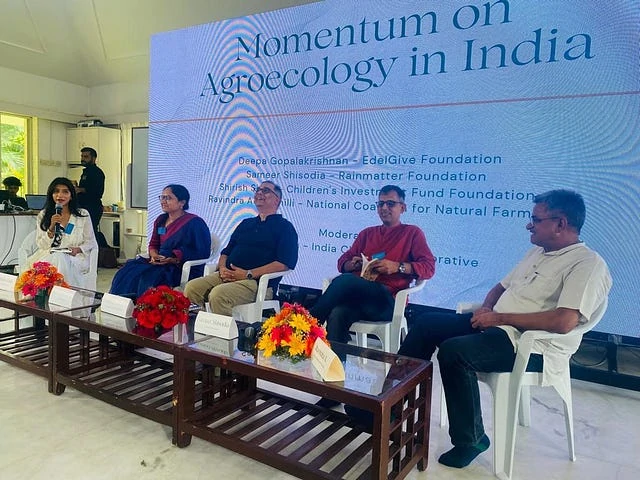
Scaling agroecology in India: The role of donors and funders
Dr. Ajita Tiwari Padhi, Senior Specialist-NbS and ...

The need for a Global Constitution
Given the attack on global multilateralism; withdr...

Subscribe to our Newsletter
Join ICC's monthly newsletter and read more about uplifting climate narratives, innovative solutions, and other updates.
