
Food systems, at India’s inaugural climate week, emerged as a mirror to our climate choices, revealing how production, markets, nutrition, and livelihoods are tightly braided together in a warming world. The conversations asked us to move beyond productivity alone and toward regeneration, collective ownership, and redesigned finance, so that the future of food in India is not extractive and fragile, but nourishing, equitable, and climate-ready.
Nature, Food, & People: Resilient Pathways for the Global South

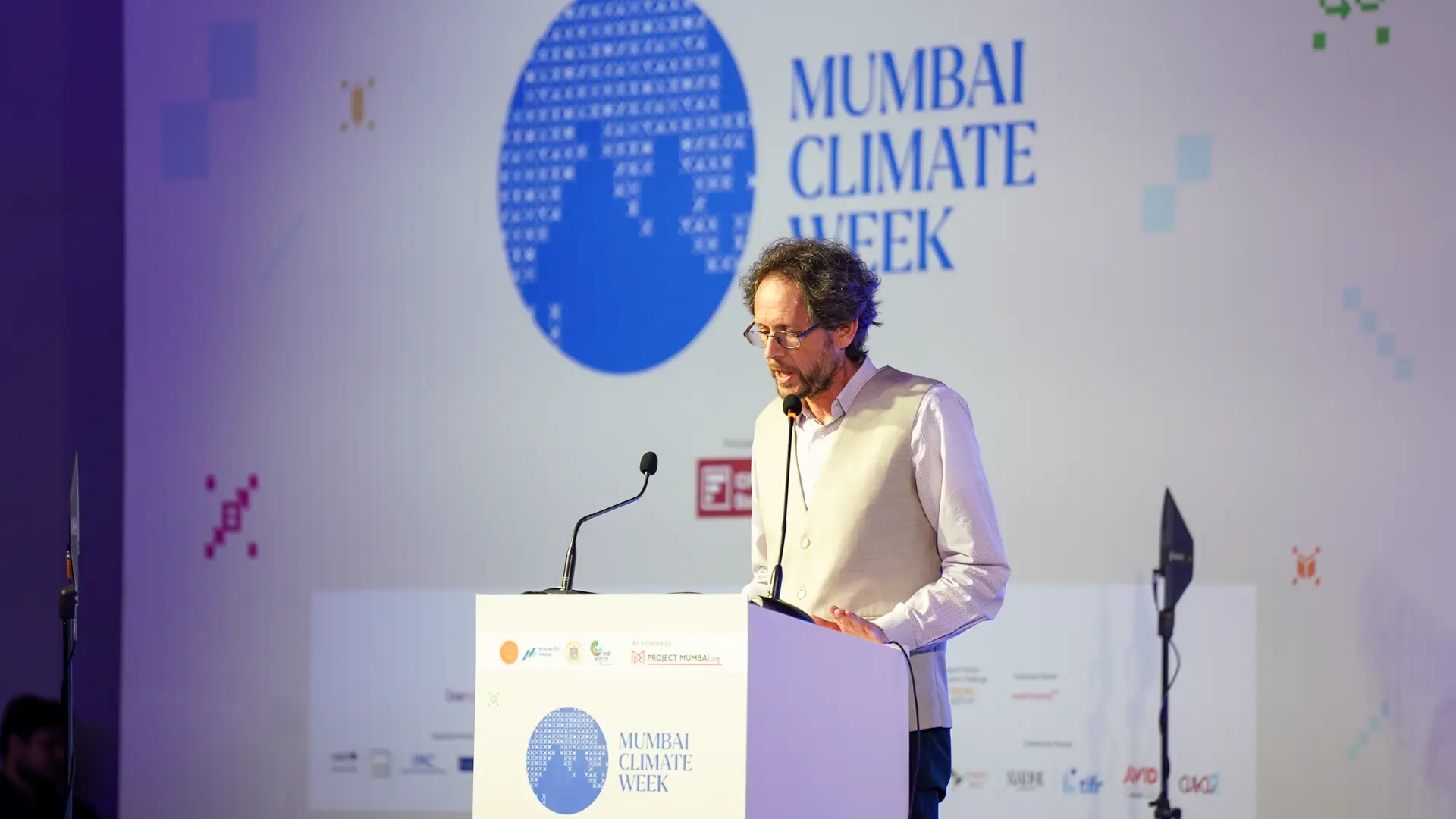
Speakers: Bharat Kakde - BAIF; Cynthia McAffrey - UNICEF; David Kennedy - SBTi; Manoj Kumar - Naandi Foundation; Shloka Nath – India Climate Collaborative
What follows is a reflection on what we heard, what challenged us, and what we must now collectively act on.
Those who feed the world cannot remain its most vulnerable.
Shloka opened the session by situating food systems within the broader architecture of compounding climate risk. With smallholder producers growing 75% of the world’s food and securing nutrition for billions, she lamented that those least equipped to absorb volatility are often the most exposed to it. The framing invited the room to consider food not as an abstract problem of calories and production, but as a system that connects nature, people and climate. David extended this tension by positioning food systems as both victim and contributor of the climate crisis. Growing food leads to significant environmental degradation, biodiversity loss and accounts for ~21 percent of global greenhouse gas emissions, making food systems transformation a critical lever for both climate and development progress in the Global South. Bharat grounded the conversation in practice, describing BAIF’s ‘producer-first’ approach across livestock, natural resource management, soil, water, and agri-voltaics, demonstrating that economic diversification can work for people and the planet. Manoj built on this through Naandi Foundation’s Araku model, where long-term partnerships that prioritise trust and patience over short-term gains help create the right enabling conditions for community stewardship and collaboration. Cynthia introduced a lens for protecting the most vulnerable – children, through effective nutrition strategies, emphasising the first 1,000 days of life as a critical entry point for coordinated action. The discussion converged on a shared understanding that resilient food systems require diversification, collective ownership, patient capital, and policies grounded in the principles to Protect, Empower, and Renew.
Financing the Food Systems Transition in the Global South

Speakers: Dr. Anjali Acharya - Nature Conservancy in India; Jinesh Shah - Omnivore, Matilda Lobo - IndusInd Bank; Neha Khanna - Climate Policy Initiative;
Ravindra Singh Negi - Bank of Baroda.
Design finance for systems, not silos.
Neha began the session by challenging a familiar instinct that more capital will automatically transform food systems. What matters, she argued, is how finance is deployed and whether it aligns with farmer economics, climate risk realities, and viable long-term business models. The framing invited the room to move beyond questions of quantum and toward questions of design. Dr. Anjali extended this tension, positioning finance as necessary but insufficient. Without landscape-level planning, climate risk intelligence, and strong local institutions, funding fragments rather than compounds, leading to stranded assets for producers and financial institutions. Capital, she argued, must be layered with decision-support systems and embedded within thoughtful ecosystem design to generate meaningful outcomes. Ravindra shifts the conversation toward execution by reiterating that the sector does not lack pilots or intent but lacks alignment. Moving from isolated initiatives to scalable, landscape-level action requires coordinated finance, governance, and community systems. Matilda and Jinesh reinforce viable revenue pathways, the resilience of India’s entrepreneurs and small businesses, and farmer institutions as the true intermediaries of scale. This conversation ensured the focus stayed on designing finance that strengthens systems rather than fragments them, as the critical lever for food transformation. The discussion converged on a shared conviction that the critical lever for food systems transformation is not the volume of capital deployed but the quality of the systems it is designed to strengthen.
Scaling What Works in India: From Pilot to Nationwide Agroecology
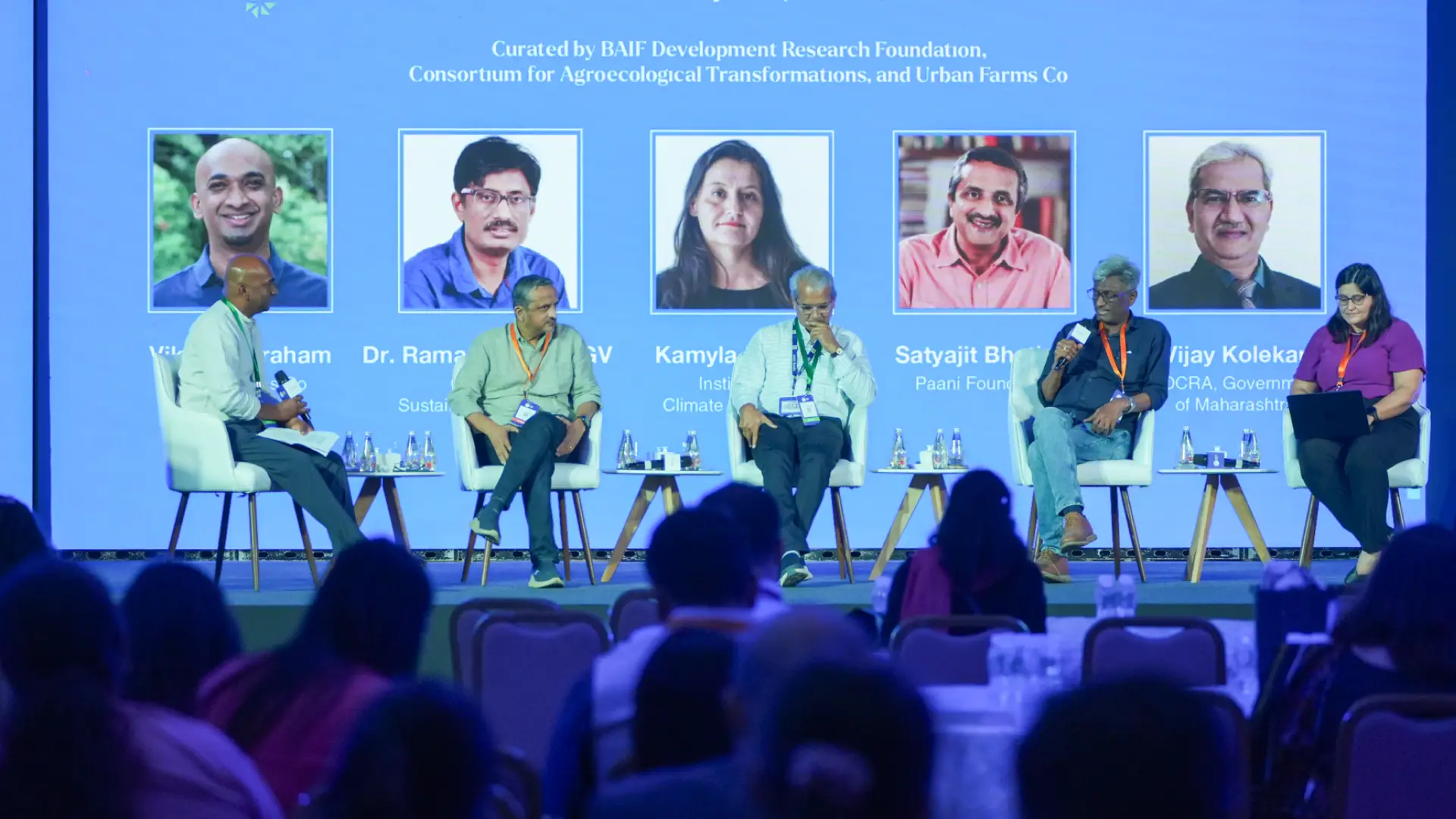
Speakers: Kamyla Borges - ICS Brazil; Ramanjaneyulu GV - CSA; Vijay Kolekar - POCRA, Govt. of Maharashtra; Satyajit Bhatkal - Paani Foundation;
Vikas Abraham - Urban Farms Co.
Farmers cannot carry transition risk alone.
Vikas addressed a persistent paradox, that agroecological models have demonstrated impact for both people and planet, yet remain marginal in scale. Ramanjaneyulu deepened this reflection by pointing to the structural realities of subsidies, incentives and policies that continue to favour synthetic-input farming, despite increasing environmental and public health risks. For smallholder producers to change how they grow food is not easy. The financial, technical, and market architecture places the full burden of transition risk on smallholders, unless government or markets actively intervene. Satyajit then shifted the conversation from individual action towards collectivisation, drawing on Paani Foundation’s watershed experience in Maharashtra. When communities organise around water, they do more than solve for a resource constraint. They build trust, shared purpose, and the social infrastructure required to manage common goods. In his view, collectivisation is not an add-on but the foundation for scaling any ecological transition. Vijay reflected on Maharashtra’s Program on Climate Resilient Agriculture, which translated national climate research into sequenced, state-level interventions tailored to local stressors. He acknowledged that cross-departmental coordination remains one of the most difficult operational challenges, addressed in part through a consortium model built on partnerships with stakeholders across academia, civil soceity and private sector. Kamyla then brought in Brazil’s experience with mainstreaming agroecology, describing coalition models that link public credit, institutional markets, and multi-stakeholder alignment that is helping pilots scale beyond funding cycles. The conversation aligned on the fact that scaling requires shared risk, patient and long-term capital that can absorb risk, coordinated institutions, and collective action.
Technology and the Services Economy for a Climate Smart Agricultural Transformation
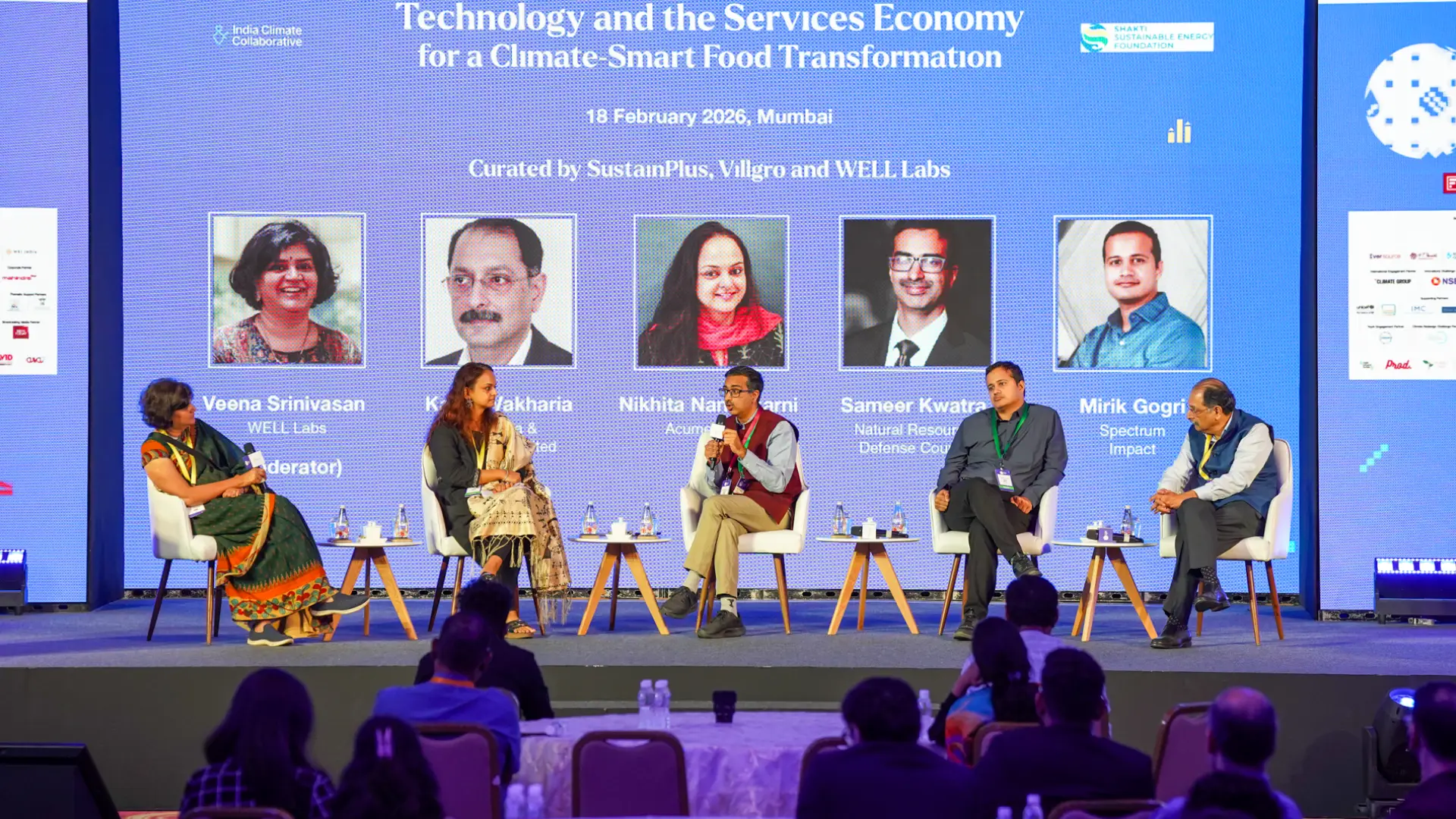
Speakers: Kairas Vakharia - Mahindra & Mahindra Ltd; Mirik Gogri - Spectrum Impact; Sameer Kwatra - NRDC; Nikhita Nadkarni - Accumen;
Dr Veena Srinivasan - Well Labs
If it doesn’t work for the farmer, it won’t work at all.
Veena started by questioning the assumption that a climate-smart agriculture transformation depends on deep-tech disruption. Instead, the discussion emphasised that technology as an enabler, must be context-first, grounded in agro-climatic realities, gender dynamics, and local socio-economic conditions rather than deployed as a standalone intervention. Kairas explored how simple, execution-driven service models, when paired with appropriate technology, can unlock multiple co-benefits, including women’s entrepreneurship, emissions reduction, and rural income diversification. Nikitha shared examples of technology-enabled rural micro-enterprise illustrating that accessibility, trust, and delivery matter more than sophistication. Mirik cautioned against techno-solutionism, noting that technology cannot compensate for weak policy, fragmented finance, or misaligned incentives. Sameer stressed that for permanent adoption to occur, innovations must generate clear economic returns and be supported by last-mile service ecosystems. The conversation ultimately noted that hyperlocal experimentation and strong community partnerships are essential to de-risk innovation and translate technological promise into a climate-smart agricultural transformation.
Leading with Participatory Action: Communities and Regenerative Food Futures

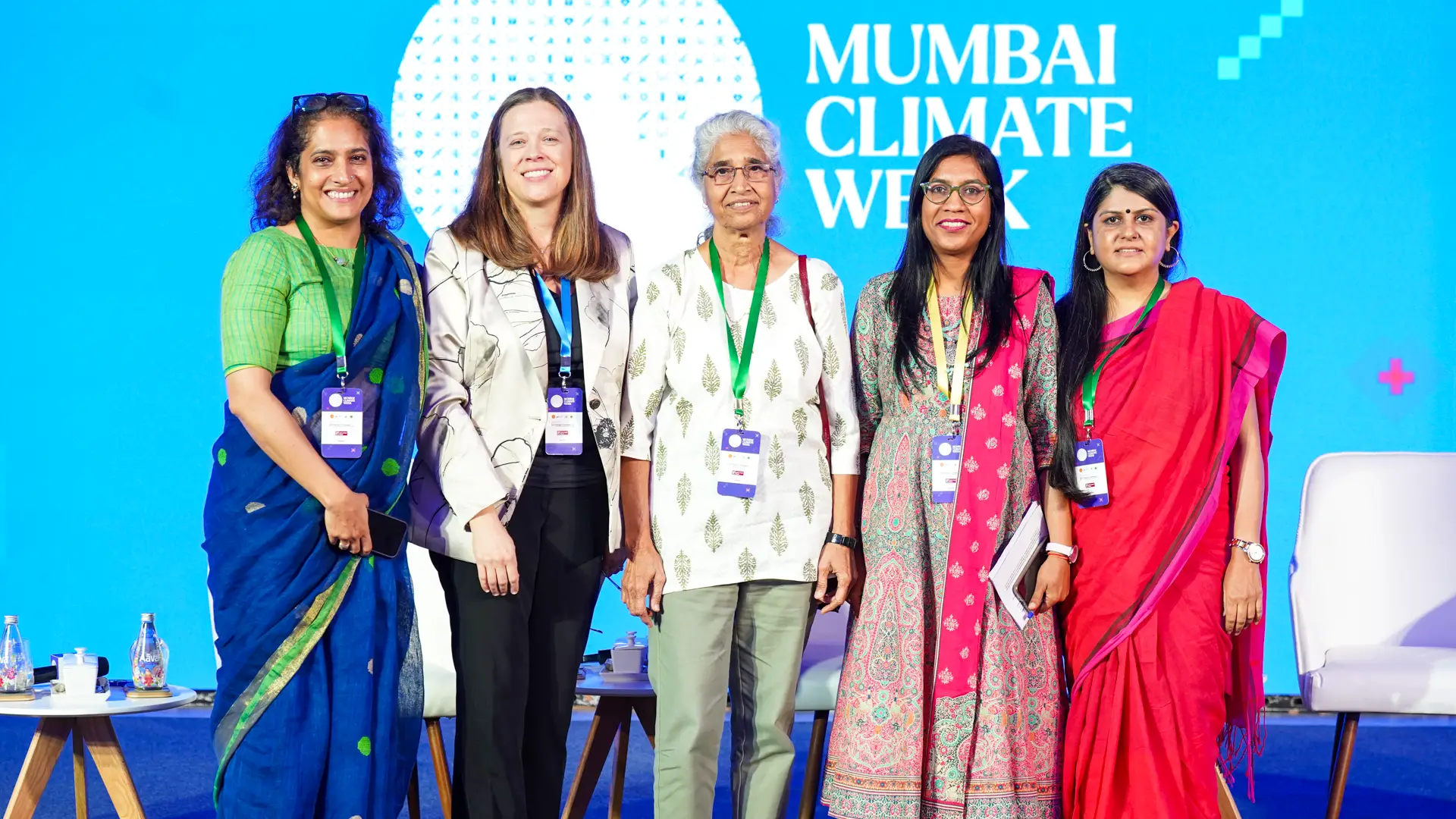
Speakers: Amanda Leland - Environmental Defense Fund; Mandira Kalra - Purpose; Marcella D’Souza - WOTR; Nidhi Jamwal - Journalist; Neha Khara - GIZ India
Consultation is not enough. Share power.
Mandira reframed participatory action as shared authorship over collective futures rather than consultation. While exploring the increasing vulnerabilities of global south rural communities, Amanda highlighted how effective people-first climate action can deliver wins across livelihoods, health and nutrition, and climate simultaneously. Marcella reflected on WOTR’s work in the arid regions of Maharashtra across three decades, where the true measure of success lies in what continues after funding cycles end. She emphasised that building local institutions and knowledge systems is what allows resilience to endure beyond projects. Neha, further on, strengthened the language by describing communities as system actors, not beneficiaries. This shift calls for longer timelines, landscape-based approaches, and accountability structures aligned with systemic change. Nidhi introduced a media perspective, questioning whose knowledge is recognised as legitimate, and why protecting the agency of vulnerable voices and marginalised communities must be non-negotiable. Grassroots adaptation stories rarely shape formal climate plans, and empowering communities to document their realities, without romanticising them, is critical. The discussion ultimately affirmed that regenerative futures depend on co-design, shared ownership, and institutions that treat community agency as foundational rather than peripheral in their investment and implementation plans.
Building Better Market Ecosystems: Producer se Consumer Tak
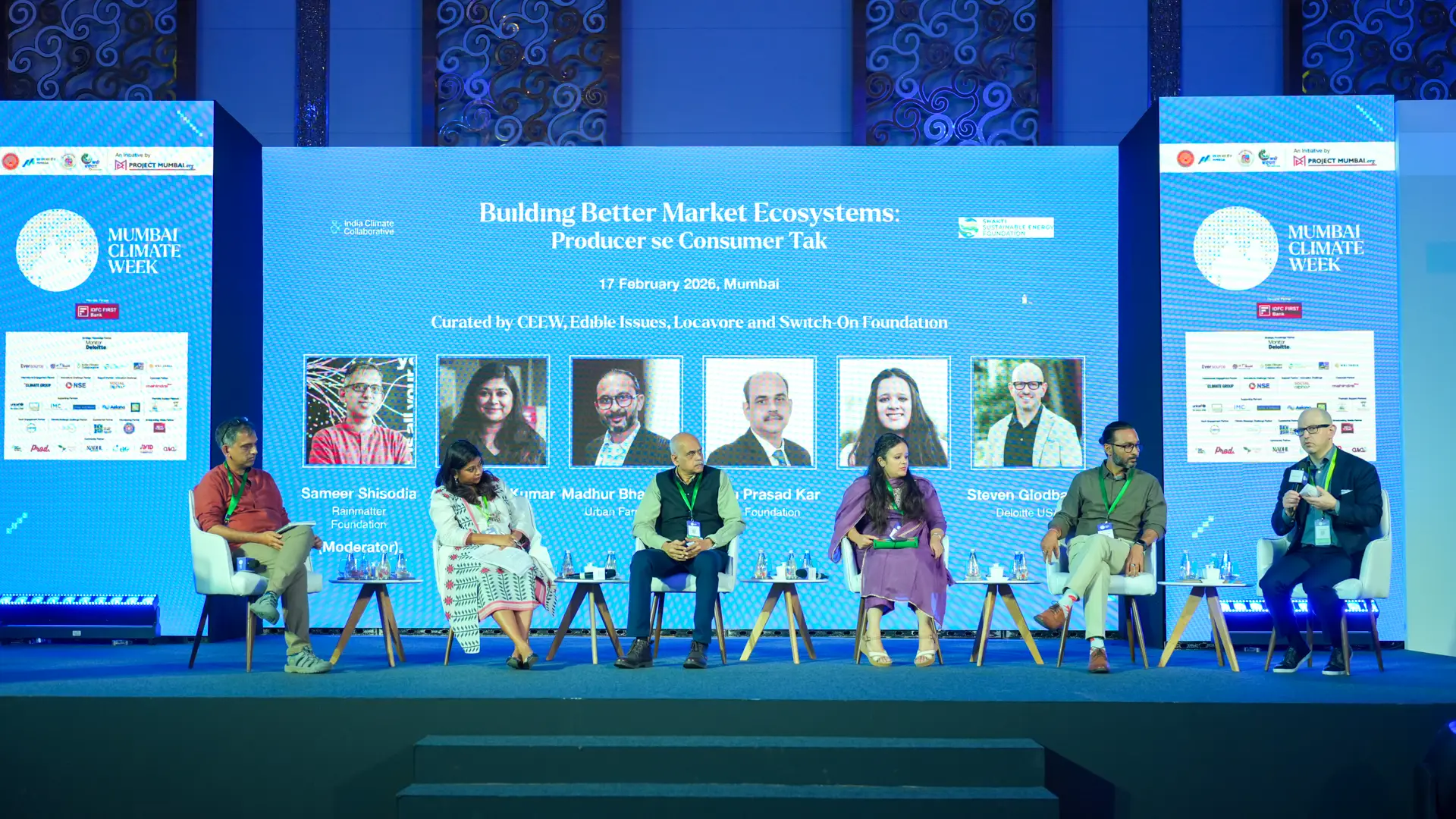
Speakers: Anjalli Ravi Kumar - Eternal; Bibhu Prasad Kar – NABARD; Madhur Bhatnagar - Urban Farms Co; Nidhi Pant - S4S; Steven Goldbach - Deloitte USA;
Sameer Shisodia – Rainmatter Foundation
Making the bazaar work for people.
Sameer set the tone for the session by calling out the structural imbalance at the core of food markets across the Global South — farmers are incentivised to produce faster, more, and cheaper, yet sustainable practice rarely receives meaningful reward. The market, as currently designed, does not price what matters. Nidhi and Bibhu extended this diagnosis, arguing that the demand–supply gap is less a problem of production and more one of information and incentives. Farmers operate with limited visibility into consumer preferences, even as value migrates steadily upstream along the chain. The farmer produces, while others capture. Madhur sharpened the lens by questioning how quality itself is defined. When premium is tied to visual appearance rather than nutritional composition or production method, the market actively redirects reward away from those who invest in sustainable and regenerative practice. In many ways, market signals are wrong by design. Steven reframed the issue as one of deliberate system architecture. Buyers, he argued, are not passive actors, they can redistribute risk through bridge financing, traceability payments, and long-term procurement commitments. Anjalli added that corporates and quick commerce platforms have an underutilised role as choice architects, capable of using data and platform defaults to close the distance between consumer intent and sustainable supply. The discussion converged on a shared conviction that market transformation is not a matter of better intentions but of redesigned incentives. When risk-sharing, value distribution, and information flows are aligned at the farm level, resilience becomes commercially legible, and the bazaar can finally work for the people who feed it.
Written by Apurva Desai, Senior Communications Manager at the India Climate Collaborative

Related



Subscribe to our Newsletter
Join ICC's monthly newsletter and read more about uplifting climate narratives, innovative solutions, and other updates.
